Arts Education and Cultural Diversity by Chee-Hoo Lum & Ernst Wagner
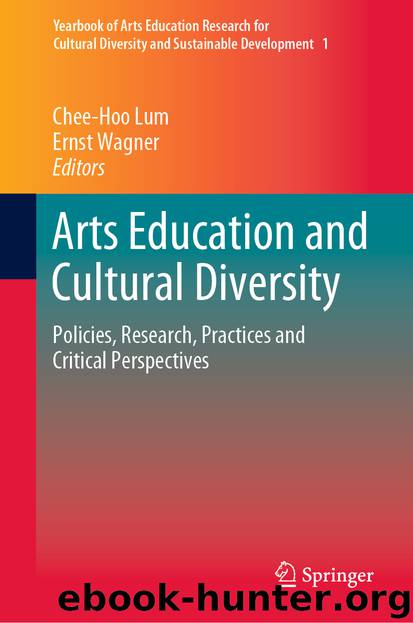
Author:Chee-Hoo Lum & Ernst Wagner
Language: eng
Format: epub
ISBN: 9789811380044
Publisher: Springer Singapore
Youth Theatre and the Politics of Imaginative Engagement
Youth theatre is essentially theatre that is created about young people, for young people, and most often by young people. It focuses on issues that are relevant to youth, in their time and space, giving agency to those who participate and make decisions about content, form and style. As such it can motivate young people to look deeply and critically at their stories, and question ideas that perplex or disturb them. Using the imaginative medium of theatre, they are prodded to envisage alternative frames for understanding and interpreting these issues, and posit ways of revising normative beliefs and attitudes through performing stories that reconfigure how reality is perceived and apprehended. Difference as divisive can then be reinterpreted and reframed in relation to these options for change.
When young people develop their own theatre and make choices about what to say and how to stage this, they effectively articulate and embody the perspectives and anxieties that prevail in their world. They also engage in taking responsibility for their actions and interpretations, negotiating differences of opinion in relation to the sociopolitical and aesthetic issues that emerge. In his book entitled Youth Theatre: Drama for Life, Michael Richardson (2015), outlines an ethos for youth theatre that is focused on giving young people a space to develop their voices and skills through collaborative and creative processes that are facilitated by adult practitioners or youth leaders who take on this work. While adult facilitators may guide and provide important references, the key questions and ideas performed are meant to reflect what the participants feel, believe and think about in relation to their topic. As such Richardson posits that ‘youth theatre delivers creative freedom for young people’ and functions to ‘support the development of personal, social, learning and creative skills’ (p. 5). These are not just relevant to the performance they make, but to everyday choices that affect their reality.
What makes this imaginative engagement conducive to ‘creative freedom’ and why does it take on the responsibility of ‘support’ for young people? In describing and explaining what is involved, Richardson emphasizes the environment in which this work takes place, and points to how the practices draw from the ‘techniques of youth work, non-formal education, and theatre’ (p. 13), highlighting the complexity of the work, which he positions on a continuum between informal and formal learning. With its learner-led and task oriented focus, participants are engaged in the effective accomplishment of meaningful tasks, and not just the fulfilment of prescribed ways of doing or replicating what has already been done and known. There is a spirit of critical inquiry and imaginative invention that is central to the investment of participants and subsequent ownership of the work that is shared between those involved. The freedom to invent stories, develop characters, propose staging ideas and design sonic and visual languages for performance, comes with responsibility and discipline, as young people navigate decision-making and independent thinking in the work that is done with, for and by them.
Download
This site does not store any files on its server. We only index and link to content provided by other sites. Please contact the content providers to delete copyright contents if any and email us, we'll remove relevant links or contents immediately.
International Integration of the Brazilian Economy by Elias C. Grivoyannis(111057)
The Radium Girls by Kate Moore(12026)
Turbulence by E. J. Noyes(8047)
Nudge - Improving Decisions about Health, Wealth, and Happiness by Thaler Sunstein(7706)
The Black Swan by Nassim Nicholas Taleb(7128)
Rich Dad Poor Dad by Robert T. Kiyosaki(6632)
Pioneering Portfolio Management by David F. Swensen(6300)
Man-made Catastrophes and Risk Information Concealment by Dmitry Chernov & Didier Sornette(6019)
Zero to One by Peter Thiel(5799)
Secrecy World by Jake Bernstein(4751)
Millionaire: The Philanderer, Gambler, and Duelist Who Invented Modern Finance by Janet Gleeson(4478)
The Age of Surveillance Capitalism by Shoshana Zuboff(4291)
Skin in the Game by Nassim Nicholas Taleb(4248)
The Money Culture by Michael Lewis(4207)
Bullshit Jobs by David Graeber(4190)
Skin in the Game: Hidden Asymmetries in Daily Life by Nassim Nicholas Taleb(4004)
The Dhandho Investor by Mohnish Pabrai(3764)
The Wisdom of Finance by Mihir Desai(3746)
Blockchain Basics by Daniel Drescher(3581)
